Where the Money Goes
Every year, billions in music royalties are collected but never reach the rights holders who earned them. The industry calls this “leakage” and treats it as an inevitable cost of complexity. It isn’t. It’s a series of specific, mappable failures—and this is that map.
A taxonomy of 12 lifecycle stages through which royalties disappear, identified through cross-reference analysis of 3.2 billion records from 15 independent data sources. More than 160 distinct failure modes. Every one observed in real catalogue data.
The music rights ecosystem is a relay race run in the dark. A song is created, recorded, registered, verified, linked, exploited, and—eventually—paid for. At each handoff, data must pass correctly from one system to the next. When it doesn’t, royalties disappear. Not dramatically. Not visibly. They simply stop flowing to the people who earned them. Rights holders discover the gaps retroactively—years after the fact, one work at a time, usually by accident.
This paper proposes a different approach: a taxonomy of royalty leakage organised by lifecycle stage. Drawing on programmatic comparison of identifier fields, registration records, and exploitation signals across 3.2 billion records from 15 independent data sources, we identify 12 distinct points in the lifecycle of a musical work where royalties can be lost, delayed, or misdirected. Each stage has its own causes, its own symptoms, and its own detection methods. Together, they form the first systematic map of where the money goes.
The infrastructure that processes music royalties is itself a source of silent failure. As we explored in The Black Box Problem, IT migrations, system changes, and back-office transitions routinely redirect revenue without anyone noticing. What follows maps not just the data failures, but the structural ones—the points at which the chain of custody between exploitation and payment quietly breaks.
Twelve Stages, One Lifecycle
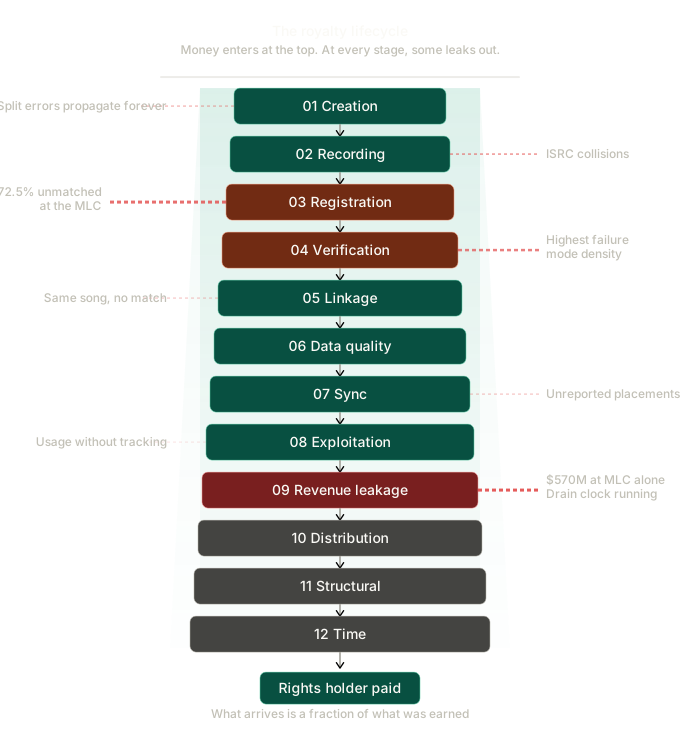
A musical work passes through 12 stages between creation and collection. At each stage, specific failure modes cause royalties to leak from the system.
Before examining each stage in detail, here is the complete lifecycle. Money enters at the top. At every stage, some leaks out. The red lines show where the biggest losses occur—and the pipe narrows as royalties drain away.
The bar chart below shows how failure modes distribute across the lifecycle. Each bar represents the number of distinct failure patterns we have identified at that stage—specific, testable conditions under which royalty flows break down.
Two stages dominate: Verification (Stage 4) and Revenue Leakage (Stage 9). But the earlier stages—Creation, Recording, and Registration—are where root causes originate. A verification failure at Stage 4 almost always traces back to a data quality issue at Stage 1 or a registration gap at Stage 3. The later stages are where the consequences become financial.
These figures cover publishing and mechanical rights. An additional 55 failure modes address neighbouring rights (PPL, SoundExchange, MLC mechanical), and 16 more handle cross-source validation and cross-domain detection. The complete taxonomy encompasses more than 160 distinct failure modes across the full spectrum of music rights.
Creation: Where the Data Should Begin
Before a song is registered anywhere, its ownership is determined. This is where the data that governs every downstream royalty payment is supposed to originate.
Before a song has an ISRC, a tunecode, or an IPI match, writers agree on splits. Samples are cleared—or not. Contributors are credited—or forgotten. Metadata standards at the point of creation are minimal to nonexistent. Split agreements are often verbal. Co-writers may not have society affiliations. Sample clearances lag behind release dates.
What makes creation-stage failures particularly damaging is their invisibility to downstream systems. A collecting society can only verify what has been registered. If the underlying splits are wrong—or never recorded at all—every registration built on top of them carries the error forward. A 5% split discrepancy at creation becomes a 5% revenue misdirection at every subsequent stage, in every territory, for every right type, for the life of the work.
Recording: Identity Fragmentation
A single composition can generate dozens of recordings. When their identifiers collide, are reused, or aren’t assigned, recordings can’t be linked to their underlying compositions.
The original studio version. A radio edit. An explicit version. A clean version. An acoustic session. A live recording. Remixes. Each recording needs its own ISRC (International Standard Recording Code, ISO 3901). When ISRCs collide, are reused across labels, or simply aren’t assigned, the recording can’t be linked to its underlying composition—and the royalties it generates have nowhere to go.
Our analysis of 256 million Spotify tracks cross-referenced against MLC and PRS data reveals persistent identity fragmentation. The same composition appears under variant titles, different artist credits, and sometimes different ISRCs across platforms. As we documented in How ISRC Registration Gaps Cost Labels Money, an 11-layer coverage analysis of a mid-size label catalogue showed 94.7% Spotify coverage against just 50% MLC work registration—a 45-point gap where mechanical royalties disappear into holding pools.
Registration: The Publisher Gap
The single largest category of royalty leakage. Works that are commercially exploited but never registered for the relevant right type in the relevant territory.
A work can be commercially released, actively streaming on every major platform, generating royalty obligations in multiple territories—and never be registered with the relevant collecting society for the relevant right type. The structural cause is straightforward: performance rights and mechanical rights have separate registration pathways. A writer who registers with ASCAP for US performance royalties has not registered for US mechanical rights at the MLC. A UK publisher who registers with PRS for performance has not necessarily registered with MCPS for mechanical. Each society, each territory, and each right type requires its own registration.
The scale of this gap is staggering. Our analysis of the MLC’s Bulk Work Audio-Visual Registration Matching (BWARM) database found that 954 million sound recording resources had no matched musical work—a 72.5% unmatched rate. Of the works that were unclaimed at the MLC, 67.5% were registered for performance rights at ASCAP. The writers were known. The compositions were registered. But nobody had registered the mechanical right.
This is not an edge case. It is the default state for a majority of musical works in the United States mechanical licensing system. As we detailed in The Unclaimed Economy, 4.25 million works have partially or fully unclaimed mechanical royalties at the MLC—73% of them actively streaming on Spotify. The US is not unique. The same structural gap exists wherever performance and mechanical rights are administered separately.
Verification: When the Numbers Don’t Add Up
A registered work is not necessarily a correctly registered work. Shares that don’t sum to 100%. Expired identifiers. Missing cross-references.
Writer and publisher shares should sum to 100% for each right type in each territory. In practice, they often don’t. Shares are over-claimed, under-claimed, or left at placeholder values. IPI numbers—the unique identifiers assigned to rights holders by their collecting societies—may be expired, reassigned, or simply wrong. We flag these as “artifact IPIs”: identifiers that persist in society databases long after the entity they represent has changed or ceased to exist.
The International Standard Musical Work Code (ISWC) was designed to solve cross-society identification. But ISWC adoption remains partial. Many registered works lack one, and when ISWCs are assigned, they sometimes link works that shouldn’t be linked—or fail to link works that should be. Dispute processes at collecting societies can take years to resolve, during which royalties are held rather than distributed.
Of the 12 stages in this taxonomy, verification has the highest density of distinct failure modes—more than twice as many as any individual earlier stage. This reflects the combinatorial complexity: for each work, there are multiple writers, multiple publishers, multiple territories, and multiple right types, each with its own share allocation that must be independently correct.
Linkage: Same Song, Different Database
A work can be registered at every society and still not get paid—because the systems don’t know they’re referring to the same composition.
PRS identifies a work by its tunecode. ASCAP uses a different work ID. BMI uses another. The MLC, yet another. Spotify knows recordings by ISRC. MusicBrainz assigns its own identifiers. Unless these are linked, a work can be registered everywhere and still not get paid—because the databases don’t know they’re talking about the same song.
The challenge is not just identifier mapping. It’s title normalisation (is it “Don’t Stop Believin’” or “Dont Stop Believin” or “Don’t Stop Believing”?), writer name matching (is “Diane Eve Warren” the same person as “D. Warren”?), and version disambiguation (is the recording on Spotify the same one registered at PRS?). CISAC’s CIS-Net system provides a global work identifier network, but participation and data quality vary significantly across its 230+ member societies.
Data Quality: The Metadata Tax
Every piece of incorrect or missing metadata becomes a matching failure somewhere downstream. These are quiet, systemic erosions that compound across millions of records.
Duration fields that read 0:00. Territory codes that don’t map to any CISAC standard. Works attributed to labels instead of publishers. Rights type fields left blank. These are not dramatic failures. They are the everyday noise of imperfect data that, multiplied across millions of records and dozens of databases, creates a persistent tax on royalty accuracy.
Our cross-reference analysis systematically flags data quality anomalies: comparing the same field across multiple sources and identifying records where values conflict. The most common anomalies are not errors in any single database—they are inconsistencies between databases that prevent automatic reconciliation. A duration mismatch between PRS and Spotify may prevent automatic matching. A label listed as a publisher—an extremely common error—may cause mechanical royalties to be directed to an entity that has no claim to them.
The industry does not have a leakage problem. It has twelve leakage problems, occurring simultaneously, at different stages of the same lifecycle, with different root causes and different solutions.
Sync: The Unregistered Placement
Sync licensing is one of the fastest-growing revenue streams in the industry. It is also one of the least consistently reported to collection societies.
When music is placed in a film, television programme, advertisement, or video game, it generates both performance royalties (from broadcast and public performance) and mechanical royalties (from reproduction). Sync deals are negotiated directly between licensees and rights holders. The resulting placements are supposed to be reported to the relevant collecting societies so that royalties can be collected. In practice, reporting is often delayed, incomplete, or missed entirely.
By cross-referencing placement data against society registration records, we identify sync placements where the underlying work is either unregistered or registered without the territories and right types that the placement would trigger. These represent royalties that are being earned but not collected—a silent gap between exploitation and administration.
Exploitation: Usage Without Tracking
Music is exploited in more ways than ever. Not all of that usage is tracked, sampled, or reported to collection societies.
Streaming platforms, broadcast radio, satellite radio, live venues, retail spaces, fitness classes, podcasts, user-generated content, AI training datasets. The ways music is exploited have multiplied. Broadcast monitoring systems sample a fraction of total airplay. UGC platforms operate under blanket licences that may not produce per-work reporting. In many territories, public performance licensing relies on venue self-reporting.
The gap between exploitation and tracking is, by its nature, the hardest stage to quantify. What we can measure is the difference between known exploitation signals—Spotify streams, YouTube views, broadcast logs—and society distribution data. When a track has 10 million Spotify streams but no corresponding distribution record at the relevant PRO, the exploitation happened—the payment didn’t. The causes range from unregistered works to IT system migrations at collecting societies that silently drop records during processing. (We examined this infrastructure layer in detail in The Black Box Problem.)
Revenue Leakage: The Growing Pools
This is where the cumulative effect of every upstream failure becomes visible. Money has been collected. It can’t find its owner. And the clock is ticking.
Money has been collected by societies on behalf of rights holders. But it can’t be matched to a specific claimant. It sits in holding accounts. And the drain clock is running.
The MLC alone held $569.9 million in royalties across usage years 2021 to 2024—approximately $142.5 million per year, collected but not distributed. The MLC is one organisation, covering one territory and one right type. With over 230 collection societies worldwide, each managing their own holding pools for their own right types and territories, the global scale of unclaimed royalties is measured in billions.
In the UK, the MCPS holds significant sums in unmatched mechanical royalties. PRS maintains a separate pool for unclaimed performance royalties—performances that were logged but couldn’t be matched to a registered work. Our analysis identifies 14.1 million PRS unclaimed performance records spanning 2021 to 2025. Each record represents a broadcast, stream, or public performance for which royalties were collected but no rights holder was identified.
Societies hold unclaimed royalties for a defined period—typically three to seven years—before redistributing them to existing members based on market share. Once redistributed, the original rights holder’s claim is extinguished. Not because they weren’t entitled to the money, but because nobody connected the dots in time.
This creates a structural transfer from smaller, less well-administered catalogues to larger, better-administered ones. The entities best positioned to benefit from leakage are the least motivated to fix it.
Distribution: Death by a Thousand Cuts
Not all royalties are worth processing. When individual payments fall below minimum thresholds, they are held indefinitely—and the small amounts add up.
Many societies set minimum payment thresholds—typically £1 to £10 per accounting period. Royalties that fall below this threshold are held rather than distributed. For a single track, this is immaterial. For a catalogue with thousands of tracks, each earning sub-threshold amounts across multiple societies and territories, these micro-payments accumulate into material sums that may never be paid out.
The mechanism is particularly punitive for catalogues with deep back-catalogue. A track that earns £0.40 per quarter at each of five societies across three territories generates £6 per quarter in total—but none of it is distributed because each individual society payment falls below threshold. The money exists. The rights holder is known. The payment simply never triggers.
Structural: The Broken Chain
When the legal entities in the administration chain dissolve, merge, or change hands, royalties stack up against ghosts.
Publishing administration involves chains of entities: writer → publisher → sub-publisher → administrator → collecting society. When a link in this chain breaks—a company is dissolved, an administrator changes, a catalogue is sold without proper society notification—royalties accumulate against an entity that can no longer receive them.
Our analysis cross-references Companies House dissolution records against active society registrations, identifying publisher entities that have been legally dissolved but remain in society databases as active claimants. The problem accelerates during periods of catalogue consolidation. When Hipgnosis, Concord, Primary Wave, or similar acquirers purchase catalogues, society records may lag by months or years. During that lag, royalties are directed to the previous administrator—who may no longer have authority to collect them, or may not pass them through.
Time: The Expiring Window
Most retrospective claims have deadlines. By the time someone discovers the gap, the window may have closed.
Most societies impose limitation periods on retrospective claims. PRS limits backdated claims. MCPS has its own windows. ASCAP, BMI, and SESAC each apply different rules. The specifics vary, but the pattern is universal: the right to claim past royalties expires.
This creates a race between discovery and expiry. A registration gap that has existed for five years represents five years of uncollected royalties—but if the limitation window is six years, there is still time to recover most of it. Wait another eighteen months and the earliest year falls off. Wait three more and the entire claim may be extinguished. The only defence against time-barred loss is early, systematic detection—finding the gaps before the windows close, not after.
Why Leakage Multiplies
These 12 stages do not operate in isolation. Failures cascade across the lifecycle, and each fix reveals the next problem.
A work with a creation-stage split error (Stage 1) that also has a registration gap (Stage 3) and a linkage failure (Stage 5) is not three times as hard to recover. It is exponentially harder—because each fix reveals the next problem, and each problem exists in a different system administered by a different organisation.
A typical recovery for a single work might require: correcting the split agreement (contacting co-writers or their estates), registering the work at the relevant societies (plural—because each territory and right type is separate), linking the registration to existing exploitation data (title normalisation, ISRC matching, ISWC assignment), and filing a retrospective claim before the limitation window closes. Multiply this by thousands of works in a catalogue, across dozens of territories, and the scale of the administrative challenge becomes clear.
Manual auditing—the industry’s traditional approach—can catch individual failures. But it cannot systematically detect patterns across all 12 stages simultaneously. As we argued in Why TrackForge Exists, the information asymmetry in catalogue transactions is a structural problem: buyers cannot verify what sellers claim, because verification requires cross-referencing data that no single party controls.
The Neighbouring Rights Gap
A parallel set of failures affects the rights of performers and record producers—and the two systems rarely talk to each other.
This taxonomy focuses primarily on publishing and mechanical royalties, but neighbouring rights—the rights of performers and record producers to be compensated for broadcast and public performance of their recordings—have their own leakage chain. In the UK, PPL (Phonographic Performance Limited) collects neighbouring rights. In the US, SoundExchange handles statutory digital performance royalties. Neither system talks to the other.
A recording can be registered with SoundExchange but missing from PPL, or vice versa. Our cross-reference analysis of PPL and SoundExchange registration data against Spotify streaming data reveals significant registration gaps—recordings that are commercially exploited in both territories but registered for neighbouring rights in only one.
The neighbouring rights dimension adds 55 additional failure modes to the taxonomy, organised by territory and collection type. These cover SoundExchange registration gaps, PPL coverage gaps, MLC mechanical cross-validation, and compound signals where multiple neighbouring rights sources disagree.
What Systematic Detection Looks Like
The value of a taxonomy is not the taxonomy itself. It’s what it enables: specific, testable questions at every stage of the lifecycle.
A taxonomy is only useful if it changes what you do. The 12 stages above are not an academic exercise—they are a detection framework. By organising leakage into discrete, testable stages, each with defined failure modes, the problem of “are we being paid correctly?” (an unanswerable question at catalogue scale) becomes a series of specific, answerable questions. Each question produces a binary result. The combination of results across all stages produces a complete picture of a work’s royalty health—or reveals exactly where the chain is broken.
In practice, this means running each work in a catalogue through a sequence of checks—programmatically, against real data, across multiple sources simultaneously:
Registration Check
Is this work registered for this right type in this territory? Cross-reference society data against exploitation signals.
Share Verification
Do the registered shares sum to 100%? Do they match across societies? Are the IPIs current and valid?
Linkage Validation
Is the registration linked to exploitation data? Can the ISRC be resolved to a tunecode, an ISWC, a matched work?
Chain Integrity
Is every entity in the administration chain active and solvent? Is there a clear path from exploitation to payment?
Recovery Window
Is there a retrospective claim window still open? What is the earliest evidence of leakage, and how much time remains?
This is the approach TrackForge takes: systematic, stage-by-stage detection across the full lifecycle, cross-referencing 15 independent data sources to identify failures that no single dataset can reveal in isolation. The taxonomy described in this paper is not theoretical. Every failure mode has been observed in real catalogue data, validated against multiple sources, and mapped to a specific recovery pathway.
This research builds on two previous TrackForge studies: The Unclaimed Economy (March 2026), which quantified the structural gap between performance and mechanical registration at the MLC, and How ISRC Registration Gaps Cost Labels Money (March 2026), which traced the 45-point coverage gap from Spotify to the MLC. For context on the IT infrastructure failures that compound these data issues, see The Black Box Problem.
The industry treats royalty leakage as an inevitable cost of doing business. It isn’t. It’s a series of specific, identifiable failures at specific, identifiable points in the lifecycle—and every one of them can be detected, measured, and systematically addressed.
Royalty Leakage — FAQ
What is royalty leakage in the music industry?
Royalty leakage is the systematic loss of music royalties between the point of exploitation (when a song is played, streamed, or broadcast) and the point of payment (when the rights holder receives money). It occurs at 12 distinct stages in the lifecycle of a musical work: creation, recording, registration, verification, linkage, data quality, sync, exploitation, revenue collection, distribution, structural chain breaks, and time-barred expiry. TrackForge’s analysis of 3.2 billion records across 15 data sources identifies more than 160 distinct failure modes across these stages.
How much money is lost to royalty leakage?
The MLC alone held $569.9 million in unclaimed mechanical royalties across usage years 2021 to 2024. The MLC covers one territory (US) and one right type (mechanical). With over 230 collection societies worldwide, each managing their own holding pools, the global scale of unclaimed royalties runs into the billions annually. Additional leakage occurs through neighbouring rights gaps, sync reporting failures, and structural chain breaks that are harder to quantify.
What are the main causes of royalty leakage?
The three largest causes are: (1) Registration gaps — works that are commercially exploited but never registered with the relevant collecting society for the relevant right type. Our analysis found 72.5% of MLC sound recording resources have no matched musical work. (2) Verification failures — registered works with incorrect shares, expired identifiers, or missing cross-references. (3) Revenue pool drainage — collected royalties that sit in holding accounts until redistribution deadlines expire, typically 3–7 years, after which the money is redistributed to existing members rather than the original rights holder.
Related Research
Check any ISRC against Spotify, MusicBrainz, and The MLC in seconds. Identify metadata conflicts and missing registrations — the first line of defence against the leakage failure modes mapped in this article.
Try the tool →4.25 million works with unclaimed US mechanical royalties at the MLC. 67.5% registered at ASCAP for performance. A structural registration gap quantified across 3.2 billion records.
Read the research note →94.7% Spotify match. 50% MLC work registration. An 11-layer coverage analysis showing exactly where the 45-point gap opens between a label’s catalogue and its mechanical royalties.
Read the analysis →IT upgrades, system migrations, and back-office transitions that silently reshape who gets paid. The infrastructure failures that compound every stage of the leakage taxonomy.
Read the briefing →